The Gray Box Trading Blog
Insights, strategy breakdowns, and behind-the-scenes look into what really works in trading.
The Gray Box Trading Blog
Insights, strategy breakdowns, and behind-the-scenes look into what really works in trading.
8 May 2025
DISCLAIMER: The following is not financial advice and should not be taken as such. Everything contained herein is opinion and for entertainment purposes only. Reader assumes all risk.
The 4 Phases Every Smart Trader Must Master: Decode the Market Cycle
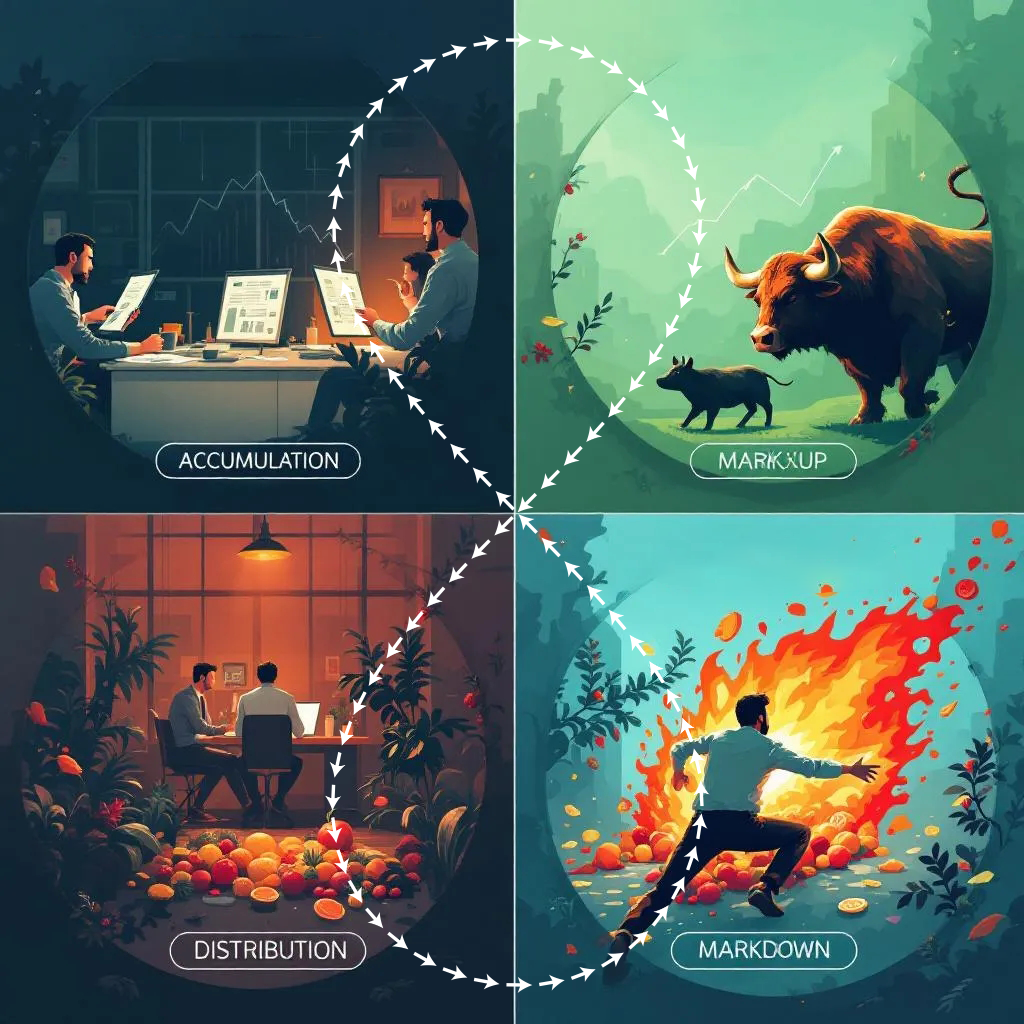
Markets, like nature, follow recurring cycles. Just as seasons change and economic conditions fluctuate, stocks move through predictable stages. Understanding these cycles can help traders and investors anticipate opportunities, manage risk, and make more informed decisions.
Every stock, sector, and the market as a whole cycles through four key phases:
Accumulation – The foundation phase
Markup – The growth phase
Distribution – The peak phase
Markdown – The decline phase
Each of these stages is driven by the psychology and actions of investors, particularly institutional players. Let’s break them down.
This stage occurs after a downtrend or period of market uncertainty. Prices move sideways within a range, showing little movement. It can last for months or even years.
During this time, large institutional investors—hedge funds, mutual funds, and other major players—begin quietly accumulating shares at low prices. They do this in a way that doesn’t immediately drive prices higher, buying strategically over time.
For the average investor, this phase often appears dull or unremarkable, leading many to ignore the stock. However, those who recognize this pattern can take advantage of the quiet before the storm, positioning themselves before the next major move.
One way to approach this phase is scaling in, meaning buying shares gradually rather than all at once. This helps manage risk and avoids paying too much if prices temporarily dip lower.
When the stock breaks above its resistance level, the markup stage begins. This signals a shift from sideways movement to an upward trend.
At this point, investors who were waiting on the sidelines start rushing in, leading to a surge in buying volume. The stock begins forming higher highs and higher lows, a sign of sustained momentum. As more traders notice the uptrend, demand increases, reinforcing the rally.
Eventually, the price movement can become parabolic, meaning it rises rapidly as excitement builds. Traders and investors track key support and resistance levels, helping them manage their positions.
One of the biggest challenges during this phase is sticking to a disciplined plan rather than chasing the stock higher. Emotions often take over, leading traders to buy too late or exit too early. The key is to remain focused on the bigger cycle at play.
This is why it is important to understand the dynamics we discussed in the Market Manipulation article.
The distribution phase marks the beginning of a shift in market sentiment. The stock, sector, or market reaches a peak, and early buyers start cashing out to secure profits.
One of the biggest red flags during this stage is high trading volume without significant price gains. This means there’s still plenty of buying interest, but sellers are matching the demand, preventing the stock from climbing higher.
As the stock struggles to make new highs, it often forms chart patterns like head and shoulders or double tops, signaling potential weakness.
At this point, some investors hold on, hoping for another leg up. But those who recognize the signs of distribution can start planning for the next phase before it fully takes hold.
This is the part of the cycle most traders fear. As selling pressure intensifies, prices decline sharply, leading to a downward spiral.
Investors who bought late in the cycle—during the distribution stage—often panic as their positions go into the red. This triggers even more selling, accelerating the decline. Since large institutional investors already exited earlier, there’s little demand left to absorb the selling pressure.
As the decline continues, prices can drop rapidly, often on higher-than-average volume. This phase eventually ends when a key support level is reached, signaling that most sellers have been exhausted. Once this happens, the cycle can begin again, moving back into accumulation.
Recognizing these four stages isn’t just about theory—it’s about learning how to trade and invest effectively. The market follows these cycles over and over, both in long-term trends and shorter-term movements.
A great way to build this skill is by studying past stock charts on a weekly timeframe. By training your eye to recognize accumulation, markup, distribution, and markdown, you can develop a deeper understanding of market behavior—and make better trading decisions as a result.
Now that you understand the four stages of the market cycle, the real value comes from experiencing them firsthand—and that’s exactly what the 90-Day Challenge is designed for. With Triangulation, our precision-built automated trading software, you’re not just observing the market—you’re actively participating in it with a system that’s built to adapt to each phase of the cycle. Over the course of 90 days, you'll see how accumulation, markup, distribution, and markdown play out in real time, and more importantly, how Triangulation responds differently in each stage to protect capital and capture opportunity. This isn’t theory. It’s market immersion—guided by automation, refined by data, and optimized for performance.
If you're serious about mastering the rhythm of the markets, don’t just study the cycle—trade through it. Join the 90-Day Challenge and let Triangulation do the heavy lifting while you focus on learning the deeper mechanics behind consistent profitability. Your edge isn’t just knowing the cycle—it’s trading it with precision. Start now.
The key takeaway? Markets will always cycle. The question is: Will you be ready when they do?
Only those who will risk going too far can possibly find out how far one can go.
- T.S. Elliot
Share On:
RECENT POST

Trader Funding Companies: Are you paying to fail?
17 June 2025
CATEGORY
Coming soon
Coming soon
Coming Soon
Coming soon
Risk Disclosure: Futures and forex trading contains substantial risk and is not for every investor. An investor could potentially lose all or more than the initial investment. Risk capital is money that can be lost without jeopardizing one's financial security or lifestyle. Only risk capital should be used for trading and only those with sufficient risk capital should consider trading. Past performance is not necessarily indicative of future results.
Hypothetical Performance Disclosure: Hypothetical performance results have many inherent limitations, some of which are described below. No representation is being made that any account will or is likely to achieve profits or losses similar to those shown. In fact, there are frequently sharp differences between hypothetical performance results and the actual results subsequently achieved by any particular trading program. One of the limitations of hypothetical performance results is that they are generally prepared with the benefit of hindsight. In addition, hypothetical trading does not involve financial risk, and no hypothetical trading record can completely account for the impact of financial risk of actual trading. For example, the ability to withstand losses or to adhere to a particular trading program in spite of trading losses are material points which can also adversely affect actual trading results. There are numerous other factors related to the markets in general or to the implementation of any specific trading program which cannot be fully accounted for in the preparation of hypothetical performance results and all which can adversely affect trading results.
Testimonials: Testimonials appearing on this website may not be representative of other clients or customers and is not a guarantee of future performance or success.
TRIANGULATION works on all markets. However, the markets available for you to trade will be based upon what is available through your broker.
Subscriptions are final. No refunds or chargebacks are permitted. We would love to guarantee your results, but we cannot control how our clients use the software. There are traders that experience incredible success. Even though we have hopes that all users will experience the same results, we cannot guarantee this.
© 2022–2025 Gray Box Trading, LLC All Rights Reserved
